Alien Reproduction Vehicle aka Fluxliner: Difference between revisions
No edit summary |
No edit summary |
||
| Line 68: | Line 68: | ||
Novel studied aeronautical engineering at Northrop Institute of Technology. Over his life Novel saw five UFOs which gave him a burning passion to learn as much as he possibly could about their technology and openly admits, without the leak of the "Alien Reproduction Vehicle" he would not have been able to write his book. | Novel studied aeronautical engineering at Northrop Institute of Technology. Over his life Novel saw five UFOs which gave him a burning passion to learn as much as he possibly could about their technology and openly admits, without the leak of the "Alien Reproduction Vehicle" he would not have been able to write his book. | ||
While Novel gives a shoutout to many scientists and their papers that influenced him, he brings up Harold Puthoff probably more than any other individual in his book and believes that the ARV's electromagnetic coil is used to polarize the vacuum relating to theoretical physics Puthoff has published on | While Novel gives a shoutout to many scientists and their papers that influenced him, he brings up Harold Puthoff probably more than any other individual in his book and believes that the ARV's electromagnetic coil is used to polarize the vacuum relating to theoretical physics Puthoff has published on that requires nullification or suppression of the zero point energy field that permeates all of our universe. | ||
Revision as of 01:16, 11 May 2026
History
Capt Harvey Williams over Provo, Utah in 1967
The very first piece of evidence regarding the existence of the “Alien Reproduction Vehicle” occurred in 1967 in the skies over Provo, Utah indicting that the U.S. government had a working prototype for almost 60 years, possibly even longer. A USAF pilot by the name of Captain Harvey Williams spotted a UFO while flying a C-47 transport plane at approximately 12,000 feet. He took a photograph from inside the plane of a saucer shaped UFO, a hemispherical dome on top, with smaller black domes spaced out on the top half of the UFO. This is the first publicly recorded sighting of a UFO matching the description of the ARV as described by “Brad”. It wasn’t until 1988 that the ARV was again seen by another member of the public.
Error creating thumbnail: File missing
Background of "Brad" and Mark McCandlish
“Brad” and Mark McCandlish first met each other while both were attending Pasadena Art Center College of Design in the late 1970s and early 1980s. It was there they honed their illustration and design skills with “Brad” studying product and transportation design and Mark studying automotive design and general illustration.
Years later “Brad” was now working for a Glendale/Pasadena area design firm where he had created a substantial clientel base. “Brad’s” business model involved creating the conceptual design and if the designs could be patented they would be patented in “Brad’s” name with the client paying for the patent fees and in turn “Brad” would provide the client with an exclusive license while they would pay him royalties. This model brought “Brad” a substantial revenue stream making him a millionaire before the age of 30.
After Mark attended Pasadena Art Center College of Design he started work as a Technical Illustrator and Publications Editor for General Dynamics later becoming an independent contractor working with other defense contractors including Lockheed Martin, Northrop, and Boeing, as well as computing titan IBM and prominent magazines Popular Science and Popular Mechanics.
It was in a magazine illustration by Mark that “Brad” decided to contact the magazine’s art director for Mark’s phone number to reach out to his old classmate from eight years ago. In the course of the conversation Mark suggestted that they attend an upcoming air show at Norton Air Force base on November 12th where a fly-by of the SR-71 Blackbird was rumored to be taking place.
Unfortunately for Mark he received a last minute phone call from Popular Science asking him to do an illustration for them over the weekend. Mark decided to take the illustration job and cancelled on “Brad” who had already made plans to attend the air show with Mark and to bring a client with him to meet Mark. “Brad” didn’t tell Mark outright who the client was other than a thin white-haired man with glasses, an Italian sounding last name, and had been a high level DoD official, Secretary of Defense or Undersecretary of Defense. Mark speculates that this man was Frank Carlucci who served as Undersecretary of Defense from February 4th, 1981 to December 31st, 1982 and as Secretary of Defense from November 23, 1987 to January 20, 1989.
Taking the art job from Popular Science over attending the air show is something Mark has regretted ever since.
Norton Air Force Base Air Show in November 12th 1988
According to McCandlish, "Brad" and the VIP attended the air show and while there the VIP took "Brad" with him to a large hanger whose access was restricted with guards posted. The VIP asked to see an individual inside, a man in a three-piece suit came out and instantly recognized the VIP. The VIP passed "Brad" off as an aide and the two were ushered inside to see the presentation in the hanger with the VIP.
Inside the hanger "Brad" saw displays of several prototype aircraft including the craft that lost to Northrop Grumman's B2 Stealth Bomber. The real star of the show was hidden behind a big black curtain. With all the delegates in the room at the display the curtain was taken back and three ARV's of different sizes but the same design and proportions were seen: 24ft, 60ft, and 120ft in diameter. It is claimed that a General gave a presentation there to the crowd which included several politicians who were deemed to have a "Need to Know". The presentation was being given to this crowd in order to get their support to fund the construction of a number of ARVs for the military including for use as tactical nuclear weapons delivery platforms as it was believed that it would be virtually impossible to stop them. Considering there are no public photos of ARV shaped UFOs since the photo in 1967 not even at the presentation at the air show in 1988 it is possible the construction of a fleet of ARVs never happened. Lastly, according to the General giving the presentation the ARV was capable of faster than light travel though it was not stated whether that was limited to the biggest ARV or if all three ARV's were capable.
"Brad's" Call with McCandlish
"Brad" was sullen and kind of freaked out after the air show and while on the phone with Mark. "Brad" opened and told Mark everything he had seen and heard at the Air Show most importantly by far, about the existence of the ARV. With "Brad's" excellent memory and Mark's excellent illustration and design skills Mark was able to create a lineart blueprint of the ARV based on the lineart blueprint "Brad" saw at the air show as well as the specific details he saw in the ARV that had been partially disassembled in order for the crowd to get a better look at it.
Mark McCandlish ARV Schematic in March 1989
In 1989, a few months after Brad told McCandlish about seeing the ARV, McCandlish had a schematic he had copyrighted drawn up of the ARV with its observed components and his interpretation of how the ARV worked. I will list the main propulsion and energy generation components below and how McCandlish believed they functioned:
Error creating thumbnail: File missing
Capacitor Array
Electromagnetic Coil
Central Column
Aluminum Flywheel Disc
Disclosure Project Press Conference in May 9th 2001
Dr. Steven Greer held a press conference with his organization known as the Disclosure Project. Numerous witnesses and other figures recounted anomalous encounters with UFOs from them shutting down nuclear launch systems to witnessing UFOs on NASA space photographs that were later scrubbed.
Mark McCandlish attended the Disclosure Project press conference as a witness where he mentioned seeing UFOs in the military but most importantly of all he displayed the lineart blueprint he had created on camera for the world to see. This was his first major public appearance discussing it since hearing about it from "Brad" about 12 years ago.
Gordon Novel's Book on the ARV in 2010
In 2003 through 2010 Gordon Novel tirelessly researched and worked on his book about the Alien Reproduction Vehicle after learning about it from Mark McCandlish titled Supreme Cosmic Secret: How the U.S. Government Reverse-Engineered An Extraterrestrial Spacecraft!
Background of Gordon Novel
Novel studied aeronautical engineering at Northrop Institute of Technology. Over his life Novel saw five UFOs which gave him a burning passion to learn as much as he possibly could about their technology and openly admits, without the leak of the "Alien Reproduction Vehicle" he would not have been able to write his book.
While Novel gives a shoutout to many scientists and their papers that influenced him, he brings up Harold Puthoff probably more than any other individual in his book and believes that the ARV's electromagnetic coil is used to polarize the vacuum relating to theoretical physics Puthoff has published on that requires nullification or suppression of the zero point energy field that permeates all of our universe.
The illustration below was on the cover.
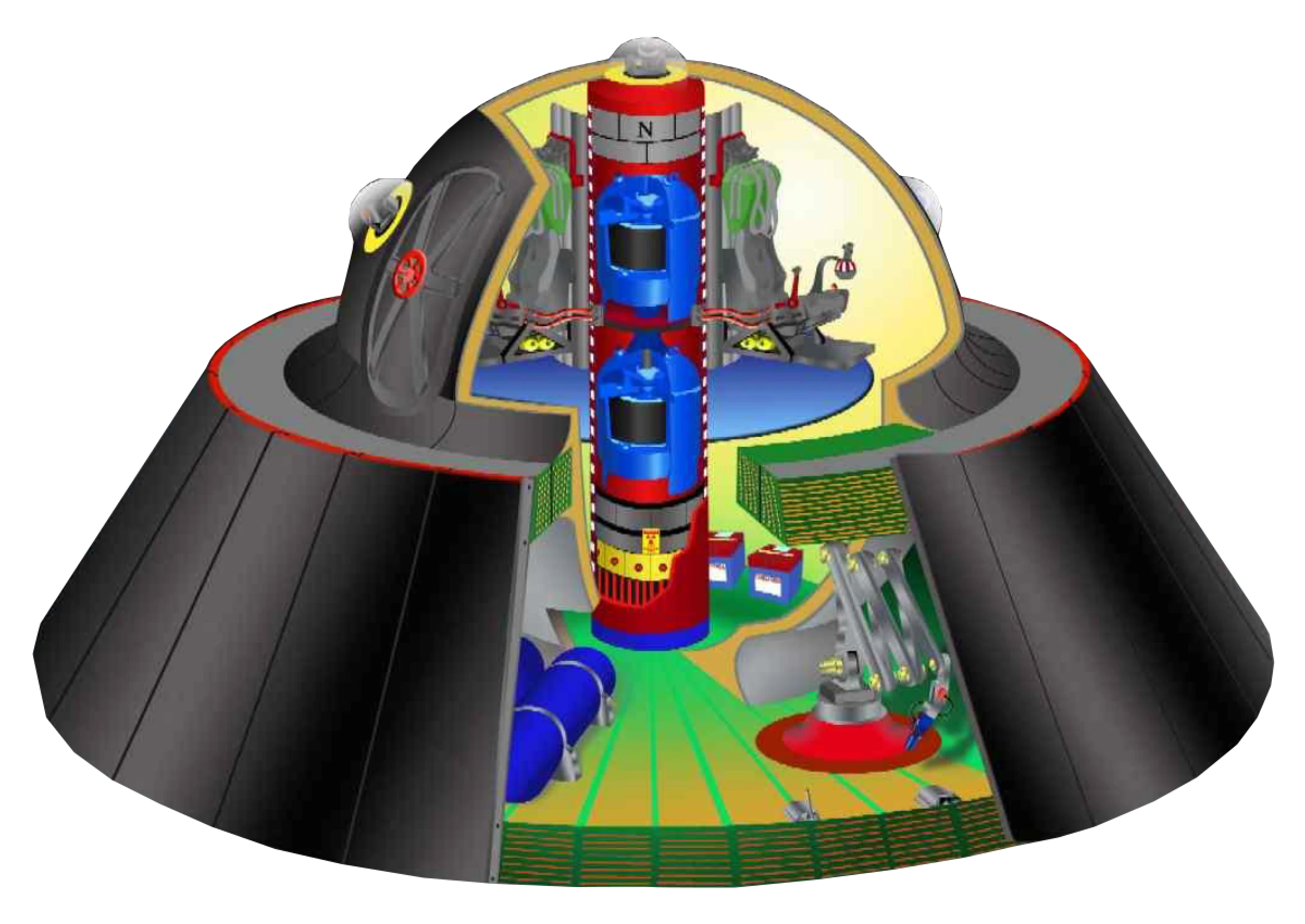
Main Components of the ARV
Slightly Asymmetrical Parallel Plate Capacitor Array
At the bottom of the craft was a parallel plate capacitor array made of 0.50 inch thick copper plates, 0.75 inch thick transparent green dielectric between the plates, and with a slight asymmetry that matched the slope of the side panels. A capacitor is simply a device with two electrodes, a lower voltage and higher voltage, with a dielectric that resists the flow of electricity between the electrodes. This indicates the ARV's propulsion system is based on the Biefeld-Brown effect.
McCandlish and Novel viewed the capacitor array as four parallel plate capacitors layered on top of each other with the bottom plate of each capacitor having a negative voltage and the top plate having a positive voltage. In keeping with this analysis only two of the capacitors in each triangular wedge could be used at the same time. The reason is that if two adjacent capacitors were powered up at the same time, the bottom capacitor's bottom plate would be negative, its top plate would be positive, and the top capacitor's bottom plate would be negative again. That bottom plate would provide a propulsive force both up and down as the plates adjacent to it both have positive voltages.
I have discovered that the capacitor array uses all eight copper plate electrodes at the same time therefore consisting of seven capacitors. It does this by having ever higher voltages on each plate in the capacitor array stack. For example, the bottom most plate would be ground or 0 Volts. The plate above it, if G10 dielectric was used as claimed by McCandlish and Nove which has a dielectric strength of 600,000 Volts at 3/4" thick, would have 600,000 Volts, then the plate above that 1,200,000 Volts, the plate above that 1,800,000 Volts, and so on reaching 4,200,000 Volts on the top most plate. With such a configuration the entire capacitor array triangular wedge could be used all at the same time.
Biefeld-Brown Effect Propulsion System
I would encourage all of you to read my deep dive Biefeld-Brown Effect Breakdown to get a complete understanding on the phenomenon.
In short, Thomas Townsend Brown in the 1920s discovered that when high voltage DC electricity was applied to a capacitor that the capacitor would move in the direction of negative to positive capacitor plate. I have discovered that the Biefeld-Brown effect mainly occurs as a result of unpaired nucleon spin alignment in the copper plates, each copper atom has one unpaired proton, as well as in the materials composing the dielectric. Despite Brown's discovery happening so long ago it has largely remained uninvestigated and misunderstood. The few BBE experiments in the public record have rarely used voltages greater than 20kV. McCandlish claimed that the ARV used voltages between 500kV and 1000kV. Novel claimed a state change occurred when voltages of 1200kV and greater were applied to the capacitors.
Gravity Shield
In GE aerospace engineer Henry William Wallace's patents in the early 1970s he stated that materials that have unpaired nucleons, such as Copper and Aluminum who have an unpaired proton, can be used as a shield to block external gravitational fields. With the capacitor array on the bottom of the craft with 0.50 inch thick copper plates, if Wallace is correct, they would shield the part of the craft above the capacitor array from Earth's gravity when the ARV is right side up.
Furthermore, it is unclear from the patents if the copper needs its unpaired protons to be spin aligned to create the gravity shielding effect but either way, if it does or doesn't the capacitor array as built in the ARV would shield Earth's gravity making the components of the craft lighter like the solenoid electromagnetic coil and the crew compartment sphere.
Lastly this could be why sometimes UFOs crash. If the a capacitor array on the bottom of a UFO is shielding the mass above it from gravity and suddenly bad weather tilts the craft, the amount of gravity reduction taking place could lessen with the craft weighing much more than it was.
Tesla Coil, Wimshurst Generator or Marx Generators?
In McCandlish's schematic and in subsequent interviews he speculates that the ARV uses a Tesla coil to generate the high voltages needed for the capacitor array on the bottom of the craft. That said he also speculated in the schematic that the flywheel could be a giant Wimshurst generator and was used to generate the high voltages.
My original take is that the craft uses cylindrical Marx generators that are seen in the bottom of the ARV sphere but not described and whose purpose was unknown in McCandlish's schematic. Marx generators output pulsed DC voltages. If you read my BBE Breakdown you would know that pulsed DC voltages are the optimum form of electricity applied to BBE capacitors. Companies such as APELC manufacture cylindrical Marx generators with a similar outward appearance to the tall cylinders in the ARV sphere.
I now believe like McCandlish that a Tesla coil is used to power the capacitor array. By connecting each capacitor plate to two inductors and outputting a Tesla coil of 4,200,000 Volts to the top inductor connected to the top most plate and Ground to the bottom capacitor plate. For example, the Tesla coil is connected to an inductor, that inductor is connected to the top most plate in the capacitor array. That plate is also connected to another inductor, that inductor is connected to the second top most plate which is connected to another inductor. That inductor is connected to the third top most plate, and so on down the capacitor array.
By creating such a tank circuit the current bounces back and forth between the capacitor array and the inductor array, depending on the resonant frequency between them as well as the Tesla coil, between tens of thousands and hundreds of thousands of times a second.
An additional benefit to this is that a Marx generator applying pulsed DC voltages to a capacitor would eventually fully charge the capacitor with a static voltage which does not work well to generate the Biefeld-Brown effect. By using a Tesla coil connected to this modified tank circuit the capacitors would continually charge and discharge preventing a static voltage from building up on the capacitors.
This hypothesis regarding how the ARV’s capacitor array functioned and how the entire thickness of the capacitor array, all eight plates, could be powered all at the same time is virtually unknown.
Electromagnetic Coil
The solenoid shaped electromagnetic coil around the circumference of the craft was said to look like braided cable in the McCandlish schematic from 1989 and square copper rod in the Novel book from 2010. In both sources the conductor was around 0.25 inches in diameter and surrounded by about 0.25 inches of green colored insulation on all sides. Traditionally, electromagnetic coils use very thin insulation coatings on the order of 1/1000th of an inch thick and the turns of the coil are as close as possible to each other to generate the strongest field. The ARV coil's design indicates high voltages are applied to the coil and therefore need the thicker insulation to prevent dielectric breakdown and arcing.
All things being equal, if the resistance of two identical electromagnetic coils is the same, the one with the higher voltage applied to it will have a higher current running through it and therefore generate stronger magnetic fields. High voltage pulsed DC current from rapidly charging up and discharging off the shelf doorknob shaped capacitors would generate a high intensity, high frequency, magnetic field around the craft.
There is a patent from an engineer in the Navy named Salvatore Pais who patented a room temperature pulsed superconductor. In the patent he describes one way of creating room temperature superconductivity in a wire is to coat a dielectric such as Teflon with a thin coating of Aluminum to the London Penetration Depth along with a wire wound spirally around the first wire with the same composition. When this is done and pulsed electricity is applied to the wire, the pulses superconduct. Such a wire could have the appearance of a braided cable as described by McCandlish.
If the ARV's coil did not superconduct I believe it is likely a very high frequency voltage was applied to the coil. This would result in what is known as the "skin effect" where currents flowing through a conductor travel very close to the surface of the conductor, hence skin. By doing this copper tubing could be used rather than solid copper rod. Coolant could flow through the copper tubing allowing higher currents without the tubing overheating.
The electromagnetic coil around the circumference of the craft would have numerous uses in an aircraft or spacecraft and is one main reason I believe in the ARV leak.
Inertial Mass Reduction
As my physics manuscript based on my magnet object free-fall and gravitational mass experiments, "Inertial Mass Reduction when Dipole Magnets Move in the Direction of North to South Pole" and Inertial Mass Reduction Breakdown demonstrate, an object with an electromagnetic field around it that is accelerating in the direction of north pole to south pole experiences a reduction in inertia on that object such that it seemingly experiences runaway progressive acceleration rates as long as the object is moving and the acceleration does not plateau. It works in ordinary rare earth magnets and I predict it works with a solenoid coil as well. Both rare earth permanent magnets and solenoid coils produce magnetic fields with a north pole and south pole. Inertia reduction in a spacecraft is a much needed component to enable rapid acceleration and transit times and I believe that is one of the reasons the ARV has a large solenoid coil around its circumference.
The Casimir effect was predicted in 1948 and experimentally verified in 1997. When two microscopic uncharged conductive plates are placed close enough together they get forced together by the energy of the vacuum. Essentially the energy of the vacuum trails off rapidly with distance but if the plates are placed close enough there ends up being more force on the outside of the plates than is inside the plates which is why the plates get pushed together when placed extremely close together.
What is creating the force demonstrated by the Casimir effect? In Quantum Field Theory it is believed virtual particle pairs are constantly popping into existence and annihilating. That minimum most amount of energy in the vacuum is called by some, Zero Point Energy. When the virtual particle pairs of positrons and electrons, pop into existence they can collide with an accelerating object as well as being attracted to each other, annihilating and creating short lived extremely high energy photons known as gamma rays. Gamma rays due to their high energy impart more momentum on objects they collide with than any other type of photon.
It is my hypothesis that these virtual particle pairs and short lived 'dark' gamma rays that are created upon their annihilation are behind the force of inertia and that the virtual particle pairs can be manipulated prior to their annihilation to decouple the craft from the energy and momentum of collisions with virtual positrons, electrons, and gamma rays which I collectively believe result in inertia reduction. I believe the vacuum fluctuations can also be engineered to generate overunity electricity but I cannot say if such a device is what powers the ARV.
Looking at the solenoid coil of the ARV it has a slope on the outer edge, the same angle slope as the capacitor array. Such an electromagnetic coil could have magnetic field lines that run parallel to sloping sides of the craft.
Using a pulsed magnetic field or a moving static magnetic field, the coil's field imparts a torque on the virtual particles of positronium causing their axis of spin to align with the magnetic field lines. When the virtual positronium annihilates two virtual gamma rays are created, one traveling up, the other down, parallel to the field lines of the magnetic coil. Instead of impacting the ARV and imparting their momentum on the craft they fly off harmlessly before disappearing back into the vacuum.
Radiation Shield
Life on Earth is protected from the radiation present in outer space thanks to Earth's magnetic field and thick atmosphere. A powerful magnetic field around a spacecraft would insulate it from cosmic rays, high energy electrically charged protons, and the solar wind, a steady stream of moderate energy electrically charged gasses. Unfortunately a magnetic field is not capable of shielding a craft from high energy photons such as x-rays and gamma rays. If the ARV is creating a gravitational field of some kind, that field could shield the craft from those high energy photons but it is unknown if such a field is being created.
Gas and Liquid Ionization
Static magnetic fields impart no energy to gasses and liquids and are not capable of ionizing the materials in such fluids. Pulsed magnetic fields on the other hand, if the pulses are of sufficiently high energy, are able to ionize gasses and liquids, breaking their chemical bonds and creating a plasma. It is my hypothesis that one use of the ARV's coil is to ionize the atmosphere around the craft.
The benefit to such an action is that the plasma can be moved out of the way of the ARV with the magnetic field as it travels allowing it to travel faster than the speed of sound without creating sonic booms.
Flywheel
Unfortunately McCandlish and Novel did not have much detail as to the nature of the flywheel in the ARV other than McCandlish claiming it had the appearance of brushed Aluminum. That said, the flywheel in the ARV could have multiple possible uses.
Reaction Wheel
A reaction wheel are often used aboard spacecraft and satellites to rotate these objects. By rotating a flywheel at high speed the objects can rotate around the axis of the reaction wheel and not need to expend any propellant. This is useful for docking with a space station like the ISS for example.
Electricity Generation
The source of electricity in the ARV is not clear as the General giving the presentation did not go into detail about it. In McCandlish's schematic he speculates that the ARV uses Condensed Charge Technology or CCT using mercury vapor, an energy source theorized by computer technology pioneer Ken Shoulders. That said, no real development of the technology has taken place publicly and no theories exist on how to generate electricity from the phenomenon.
Novel proposed a completely different source of electricity that the ARV used based on the craft's use of inertia reduction. He speculated that if inertia was eliminated that an electric motor could turn an alternator generating more electricity that it needed to power the electric motor. While eliminating inertia would allow the electric motor and alternator to spin up to operating speed immediately inertia reduction or elimination would not eliminate "back EMF". Alternators generate the force known as "back EMF" that opposes the rotation of the alternator as it rotates. Eliminating inertia does not get rid of this.
As it stands it is unclear what the power source of the ARV was. Whether it harnesses vacuum fluctuations to generate electricity, nuclear fusion, nuclear fission, CCT, or something else, at this point in time the answer is unknown.
Spherical Crew Compartment
As seen in the schematic and illustration, at the heart of the ARV lies a spherical shell. The ARV had a grey color to it when seen by Sorenson/Sanderson in 1988 but the General giving the presentation did not state what the shell was made of. That said, it is likely it was made of a material with unpaired nucleons.
As mentioned above, in 1971 Wallace patented technology based on spin alignment of materials with unpaired nucleons. In one of the patents he stated that a shell can be made of materials with unpaired nucleons that will shield the interior from external gravitational fields. In the patent it is unclear if the shell needs to have any kind of spin alignment occurring in the material or if the shell just needs to be made of suitably thick material with unpaired nucleons. In either case it is likely the spherical shell of the ARV is made of Aluminum to shield the interior from Earth's gravity and any other external gravitational fields the craft encounters in its use.
Another hypothesis is that the capacitor array on the bottom of the craft, made of materials with unpaired nucleons, when energized, creates a gravity shielding effect on the part of the craft above the capacitor array in keeping with Wallace's patent.
It is also possible that the shell has a layer of material such as mu-metal or pyrolitic carbon to shield the interior from the electromagnetic field created by the coil around its circumference. If the flywheel is not used as an engine and therefore the flywheel and coil do not work together it might make sense to shield the interior of the craft from the strong magnetic field put out by the coil.
Conclusion
And there you have it. The Alien Reproduction Vehicle leak is an incredibly detailed tale, one that to this citizen scientist is too logically thought out to be a tale of fiction created by Brad/Sanderson and McCandlish/Novel. The world will not know for sure, one way or the other, until the scientific community from academia to citizen scientists take on the hard work of conducting experiments based on and seeking to replicate the components of the ARV.
This citizen scientist has already conducted one experiment, the rare Earth magnet object free-fall and gravitational mass experiments, that can be explained as a result of inertia reduction when an object with a magnetic field moves in the direction of North Pole to South Pole. There is no reason the effect would not occur with a solenoid coil that also has a North Pole and South Pole.


